Hair growth serums have become one of the fastest-growing categories in hair care. From peptide blends to botanical extracts, almost every new launch promises thicker, fuller hair in just a few weeks. Unfortunately, not every formula lives up to those claims.
The truth is that some hair growth serums are supported by clinical research, while others rely mostly on marketing. Understanding which ingredients have real evidence can help you spend your money wisely and build a routine that actually supports healthier hair growth.
The Science Behind Hair Growth Serums
Hair grows from follicles located beneath the scalp. For a serum to make a meaningful difference, it needs to support the hair follicle, improve the scalp environment, or help extend the anagen (growth) phase of the hair cycle.
Some ingredients have stronger scientific evidence than others.
Minoxidil
Minoxidil remains the gold standard among over-the-counter hair growth treatments. It has decades of research supporting its ability to prolong the growth phase and stimulate dormant follicles in people with androgenetic alopecia.
Peptides
Peptides are short chains of amino acids that may help support healthier hair follicles and improve the appearance of hair density. While research is promising, evidence is still growing compared with minoxidil.
Caffeine
Laboratory studies suggest caffeine may stimulate hair follicles, but clinical studies in humans have produced mixed results.
Rosemary Oil
Some research suggests rosemary oil may improve hair growth over time and may perform similarly to low-strength minoxidil in certain cases. However, more high-quality studies are still needed.
Niacinamide and Botanical Extracts
These ingredients support scalp health by strengthening the skin barrier and reducing irritation. While they don’t directly regrow hair, they can create a healthier environment for normal hair growth.
Best Products to Use
1. Women’s or Men’s Rogaine 5% Minoxidil Foam
Why it’s recommended
Minoxidil has the strongest scientific evidence of any over-the-counter hair growth treatment.
Key active ingredient
- 5% Minoxidil
How it works
It extends the hair growth phase and stimulates dormant follicles to produce thicker hairs.
Who should use it
Adults experiencing hereditary hair thinning.
How to use
Apply to a dry scalp once daily for women or according to the product directions.
Precautions
Temporary shedding during the first few weeks is common. Results usually take three to six months.
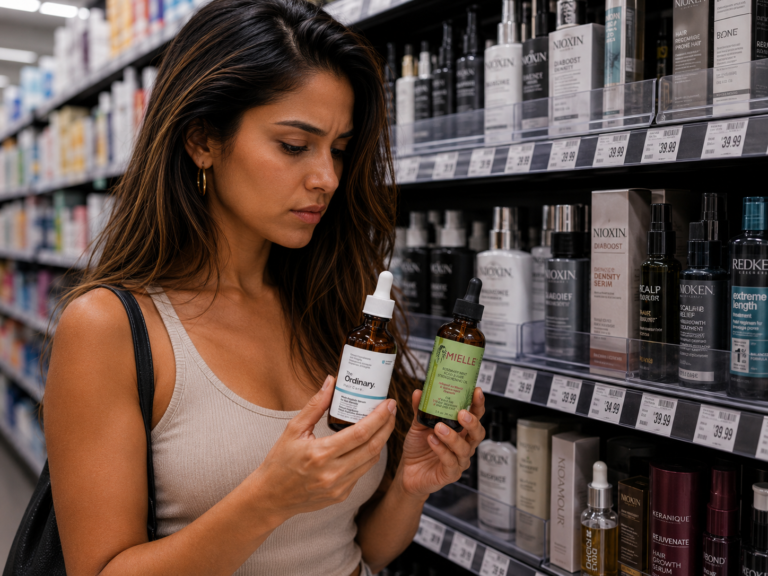
2. The Ordinary Multi-Peptide Serum for Hair Density
Why it’s recommended
One of the most affordable peptide-based hair serums with a well-balanced formula.
Key active ingredients
- Multi-peptide complex
- Caffeine
- Plant extracts
How it works
Supports scalp health while improving the appearance of fuller, denser hair.
Who should use it
People with early thinning or reduced hair density.
How to use
Apply a few drops to a clean scalp every evening.
Precautions
Visible improvements require consistent long-term use.
3. Vegamour GRO Hair Serum
Why it’s recommended
A lightweight botanical serum that focuses on improving the appearance of hair density.
Key active ingredients
- Red clover extract
- Mung bean extract
- Caffeine
How it works
Supports the scalp and helps reduce the appearance of hair thinning over time.
Who should use it
Adults with mild to moderate thinning.
How to use
Massage into the scalp once daily.
Precautions
Clinical evidence is promising but not as strong as that for minoxidil.
4. Divi Scalp Serum
Why it’s recommended
A popular scalp-focused serum designed to improve scalp health and reduce buildup.
Key active ingredients
- Tea tree oil
- Caffeine
- Amino acids
How it works
Helps maintain a balanced scalp environment while supporting healthier-looking hair.
Who should use it
People with oily, itchy, or buildup-prone scalps.
How to use
Apply directly to the scalp between washes.
Precautions
Essential oils may irritate sensitive skin. Perform a patch test before use.
5. Mielle Rosemary Mint Scalp & Hair Strengthening Oil
Why it’s recommended
A favorite for moisturizing the scalp and reducing breakage.
Key active ingredients
- Rosemary oil
- Peppermint oil
- Biotin
How it works
Conditions the scalp and strengthens the hair shaft, helping reduce breakage.
Who should use it
People with dry scalps or brittle hair.
How to use
Massage a small amount into the scalp before washing or as directed.
Precautions
Evidence for rosemary oil is encouraging but still limited compared with minoxidil.
6. Nutrafol Hair Serum
Why it’s recommended
A lightweight serum formulated to complement Nutrafol’s supplement line.
Key active ingredients
- Ashwagandha exosomes
- Peptides
- Botanical extracts
How it works
Supports scalp hydration and helps improve the appearance of fuller hair.
Who should use it
Adults experiencing gradual thinning.
How to use
Apply daily to clean scalp.
Precautions
Works best as part of a consistent long-term routine.
7. Kerastase Genesis Anti Hair-Fall Fortifying Serum
Why it’s recommended
Designed for hair weakened by brushing, heat styling, and daily stress.
Key active ingredients
- Aminexil
- Ginger root extract
- Caffeine
How it works
Helps strengthen hair at the roots while reducing breakage-related hair fall.
Who should use it
People with fragile or weakened hair.
How to use
Apply daily to the scalp without rinsing.
Precautions
Helps reduce hair fall due to breakage but does not cure medical hair loss.
What Doesn’t Work
Not every hair serum delivers meaningful results. Be cautious of products that:
- Promise dramatic hair growth in just a few weeks.
- Claim to permanently reverse genetic hair loss without clinical evidence.
- Rely solely on trendy botanical ingredients with little or no published research.
- Advertise “miracle” formulas without listing active ingredients.
Remember that healthy hair typically grows only about half an inch (1.25 cm) per month, so any product promising several inches of growth in a short period should be viewed skeptically.
Common Mistakes
Switching Serums Too Quickly
Hair follicles respond slowly to treatment.
Correct approach: Give a serum at least three to six months before deciding whether it’s effective.
Applying Too Much Product
Using more serum won’t make hair grow faster.
Correct approach: Follow the manufacturer’s instructions and apply consistently.
Ignoring the Underlying Cause of Hair Loss
No cosmetic serum can treat thyroid disease, iron deficiency, or autoimmune hair loss.
Correct approach: Persistent or sudden hair loss should be evaluated by a healthcare professional.
Expecting Every Serum to Regrow Hair
Many serums improve scalp health or reduce breakage rather than stimulating new hair growth.
Correct approach: Understand what each product is designed to do and choose accordingly.
Neglecting Overall Hair Care
Healthy hair growth also depends on nutrition, stress management, scalp care, and minimizing heat and chemical damage.
Correct approach: Combine a quality serum with a balanced hair care routine for the best long-term results.
Final Thoughts
The best hair growth serums are those backed by realistic claims and ingredients supported by scientific evidence. Minoxidil remains the most effective over-the-counter option for hereditary hair loss, while peptide-based and botanical serums can support scalp health and improve the appearance of fuller hair when used consistently.
Instead of chasing viral products or overnight transformations, focus on ingredients with proven benefits, maintain a healthy scalp, and give any treatment enough time to work. A thoughtful, evidence-based routine is far more likely to deliver lasting results than the latest social media trend.