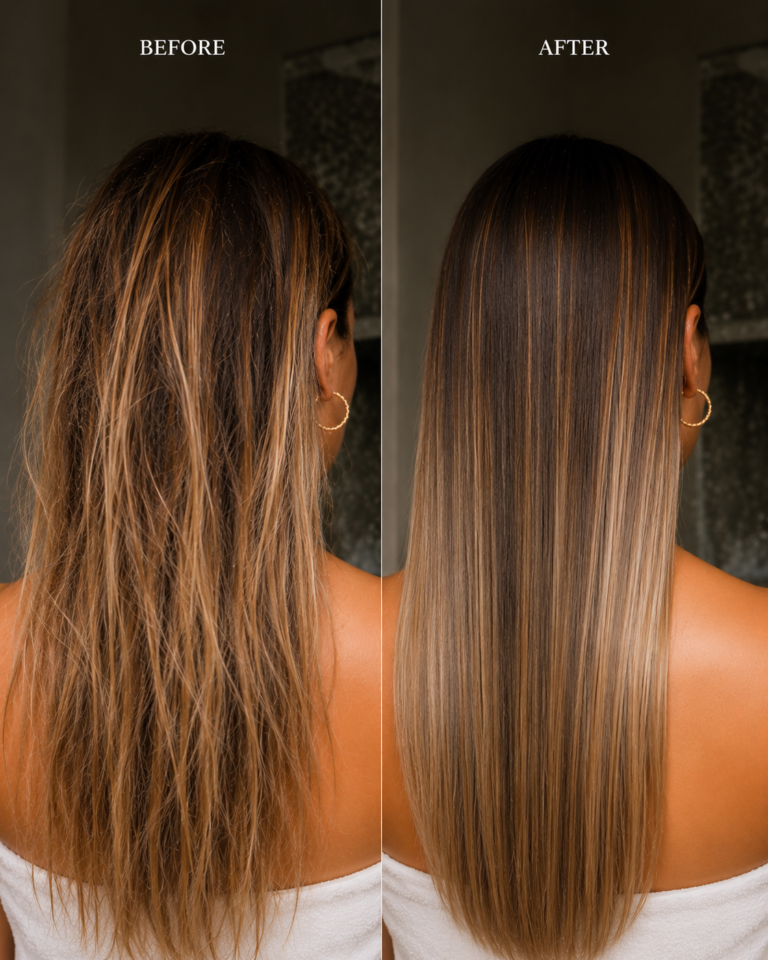
There’s a particular kind of frustration that comes with damaged hair — the kind that no dry shampoo or messy bun can fully disguise. If your strands feel brittle, look dull, or break every time you run a comb through them, your hair isn’t just having a bad day. It’s asking for help.
The encouraging part? You don’t need a salon overhaul to fix it. Most damage can be significantly reversed at home with the right products and a routine built around what your hair actually needs — not just what’s trending.
Here’s exactly how to do it.
What Causes Hair Damage?
Understanding what’s behind the damage makes it far easier to treat — and prevent it from coming back.
Heat styling is one of the most common culprits. Repeated exposure to flat irons, curling wands, and blow dryers depletes moisture from the hair cuticle, leaving strands dry, brittle, and prone to snapping.
Chemical treatments like bleaching, coloring, and perming penetrate the hair cortex and disrupt the bonds that keep hair strong and elastic. The more frequently they’re done, the more structural damage accumulates.
Tight hairstyles — high ponytails, sleek buns, braids pulled too close to the scalp — create constant tension along the hair shaft. Over time, this leads to traction breakage and thinning, particularly around the hairline.
Sun exposure is easy to overlook. UV radiation breaks down the proteins in your hair, causing color to fade and texture to roughen. Think of it as sunburn for your strands.
An inconsistent hair care routine — washing too often, skipping conditioner, or relying on harsh sulfate shampoos — slowly strips hair of the moisture and protection it needs to stay resilient.
Signs Your Hair Needs Repair
Some of these are obvious. Others are easy to miss or dismiss as normal. Look for:
- Split ends that extend further up the shaft than the tip
- Mid-shaft breakage rather than shedding at the root
- Persistent frizz that products can’t seem to control
- Dryness or rough texture that doesn’t respond to conditioner
- A dull appearance with no natural movement or shine
- Excessive tangling after washing or sleeping
Three or more of these is a clear signal that your hair needs a proper repair routine — not just more product.
How to Repair Damaged Hair at Home
Step 1: Start with a Repairing Shampoo
The most important shift you can make is rethinking your cleanser. Sulfates — the detergents responsible for that satisfying lather — are also responsible for stripping your hair of the oils and moisture it desperately needs when it’s damaged. Switching to a sulfate-free, bond-building shampoo is the foundation of any effective hair repair routine.
The Olaplex No. 4 Bond Maintenance Shampoo is one of the most well-researched options available. It’s formulated with Olaplex’s patented bis-aminopropyl diglycol dimaleate technology, which works to reconnect broken disulfide bonds within the hair shaft — the same bonds damaged by heat, bleach, and chemical processing. It’s particularly well-suited for color-treated or chemically processed hair, and a little goes a long way. Limit washing to two or three times per week to avoid over-stripping.
Step 2: Condition Every Single Time You Shampoo
Conditioner isn’t optional when you’re repairing damaged hair — it’s essential. After shampooing, the cuticle is slightly raised and vulnerable. A good conditioner seals it back down, smooths frizz, restores softness, and makes detangling dramatically easier.
Apply from mid-shaft to ends, leave on for three to five minutes, then rinse with cool water to lock in the benefits. The Briogeo Don’t Despair, Repair! Super Moisture Conditioner is a standout choice here. Formulated with B vitamins, rosehip oil, and algae extract, it delivers both protein and hydration without weighing hair down — making it ideal for fine to medium hair types that need repair without heaviness. For thicker or coarser textures, it works equally well with a slightly longer leave-on time.
Step 3: Use a Deep Conditioning Mask Once a Week
Think of a weekly hair mask as the intensive treatment your regular conditioner can’t provide on its own. While rinse-out conditioners work on the surface of the cuticle, a deep conditioning mask penetrates further into the hair cortex — replenishing moisture, restoring elasticity, and improving overall strength over time.
Apply to clean, damp hair, cover with a shower cap, and leave on for 20 to 30 minutes. The warmth trapped underneath helps the formula absorb more effectively. Olaplex No. 8 Bond Intense Moisture Mask is one of the most consistently praised options for damaged hair. It layers moisture on top of bond-building technology, so you’re simultaneously hydrating and repairing — not just masking the problem. It’s best suited for dry, brittle, or overprocessed hair and delivers noticeably softer results after just one use.
Step 4: Apply a Leave-In Conditioner After Every Wash
Once you’re out of the shower, your hair still needs protection. A leave-in conditioner extends the moisture from your shower routine, reduces frizz, and forms a lightweight barrier against environmental stressors — all without rinsing out.
Work it through damp hair from mid-shaft to ends, then style as usual. The It’s a 10 Miracle Leave-In Product has earned its cult status for good reason. It addresses ten different hair concerns in a single step — detangling, frizz control, shine, heat protection, and more — making it a genuinely efficient product for anyone building a simplified but effective routine. It’s especially well-suited for fine or normal hair types that want results without the weight.
Step 5: Never Skip Heat Protectant
If you’re still using heat tools — even occasionally — heat protectant is non-negotiable. Applying any hot tool directly to unprotected hair, especially hair that’s already compromised, undoes the repair work you’ve been building every week.
A quality heat protectant forms a thermal barrier around the cuticle and helps retain moisture during styling. The Kenra Platinum Silkening Mist offers professional-grade protection up to 428°F with a silky, non-sticky finish that works beautifully on dry or damaged hair. It’s a go-to in many salon backrooms — and for good reason. Apply to damp or dry hair before any heat tool, and use it every single time, not just on high-heat days.
Common Mistakes That Slow Down Hair Repair
Even with a solid routine in place, certain habits can quietly undermine your progress. Here’s what to watch for.
Skipping trims. Split ends don’t repair themselves — they split further up the shaft, creating more breakage. A trim every eight to ten weeks keeps damage from spreading and makes healthy hair growth visible faster.
Rubbing your hair dry with a regular towel. Wet hair is at its most fragile, and the rough cotton fibers of a standard bath towel create friction that causes breakage and frizz. Switching to a microfiber hair towel — like the Aquis Original Hair Towel — makes a genuine difference. It absorbs water more efficiently and dramatically reduces the mechanical stress on wet strands.
Detangling from root to tip. This forces knots down the shaft and snaps strands unnecessarily. Always start at the ends, working out tangles section by section before moving up toward the root. A wide-tooth comb or a gentle detangling brush used on damp hair after leave-in application is the safest approach for damaged or fragile strands.
Sleeping on rough pillowcases. Cotton pillowcases create friction as you move in your sleep, leading to tangles, frizz, and overnight breakage. Swapping to a silk or satin pillowcase reduces that friction considerably — it’s a small change that pays off in smoother, less tangled hair every morning.
Overdoing protein treatments. Protein is critical for repairing damaged hair, but too much causes protein overload, which makes hair stiff, brittle, and more prone to snapping. If your hair feels hard or straw-like after a mask, it’s a sign to balance with a moisture-focused treatment rather than layering on more protein.
Consistency Is the Real Secret
There’s no product on earth that can fix months of damage in a single wash. But the right routine, applied consistently over six to eight weeks, will absolutely move the needle — sometimes dramatically.
Think of hair repair less like a rescue mission and more like a new standard of care. Stay the course, be patient with the process, and trust that your hair has a remarkable ability to recover when you give it what it needs.