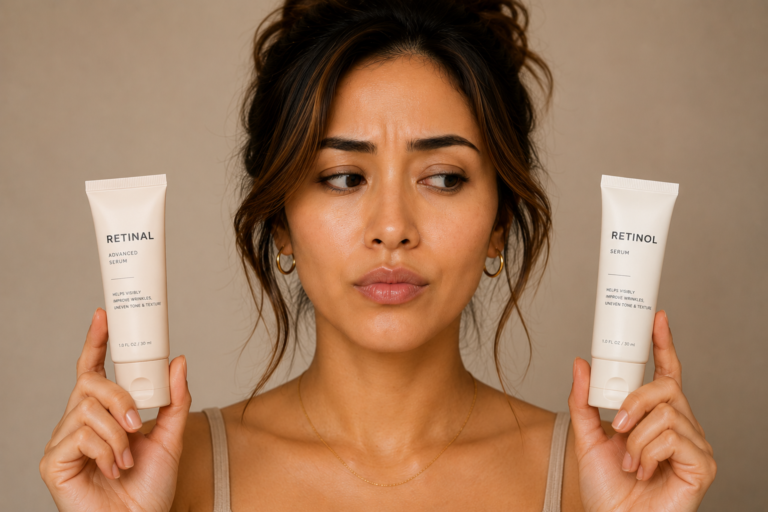
If you’ve spent any time researching skincare, you’ve probably seen the terms retinol and retinoid used interchangeably. While they’re closely related, they aren’t the same thing, and understanding the difference can help you choose the right product for your skin.
Both ingredients belong to the vitamin A family, making them some of the most scientifically studied skincare ingredients available. They’re widely recommended by dermatologists for treating acne, improving fine lines, smoothing skin texture, and reducing hyperpigmentation. The key difference lies in their strength, how quickly they work, and who they’re best suited for.
In this guide, we’ll break down the science behind retinol and retinoids, explain who should use each one, and recommend some of the best evidence-based products available on Amazon.
The Science Behind Retinol and Retinoids
Retinoids are the umbrella term for all vitamin A derivatives used in skincare. Every retinol is a retinoid, but not every retinoid is retinol.
Once applied, these ingredients bind to receptors in skin cells and help regulate cell turnover. This encourages old skin cells to shed more efficiently while stimulating the production of healthier new cells.
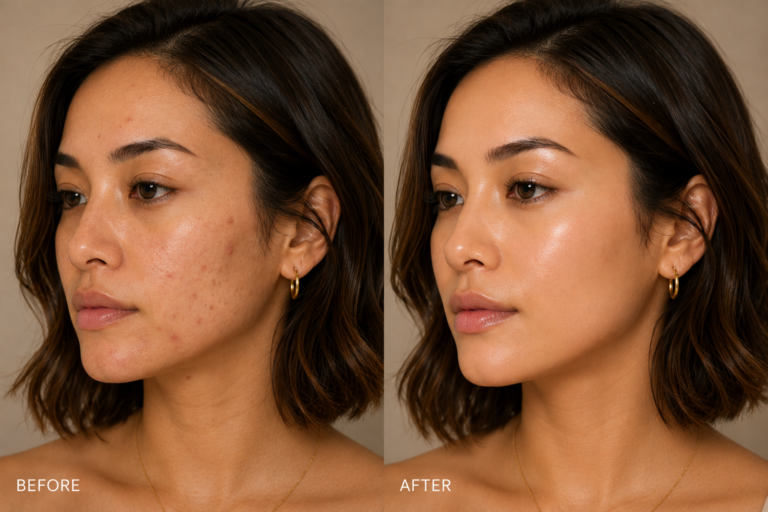
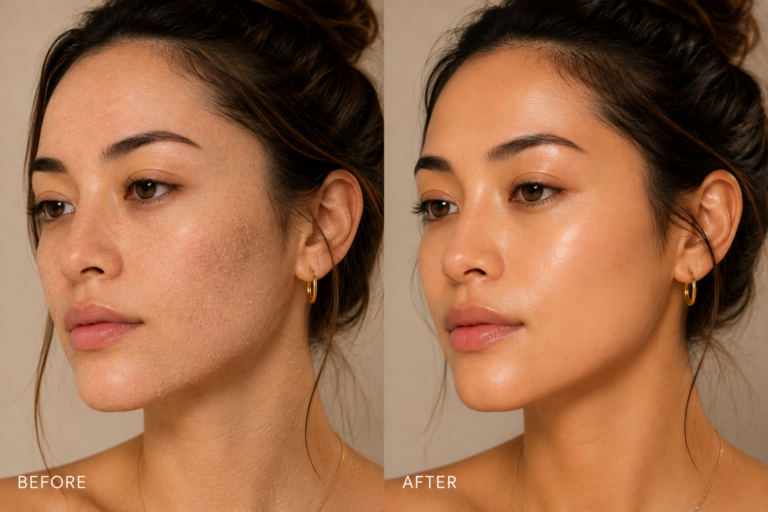
Research has shown that retinoids can:
- Improve fine lines and wrinkles
- Increase collagen production
- Reduce clogged pores
- Treat acne
- Fade post-inflammatory hyperpigmentation
- Improve uneven skin texture
- Minimize the appearance of enlarged pores
Retinol
Retinol is an over-the-counter retinoid that must be converted into retinoic acid, the active form that skin cells can use.
Because it requires several conversion steps, retinol works more gradually and is generally better tolerated, making it ideal for beginners and people with sensitive skin.
Retinal (Retinaldehyde)
Retinal is converted into retinoic acid in just one step, making it more potent than retinol while still being available without a prescription.
It often delivers faster results with less irritation than prescription-strength retinoids for many users.
Adapalene
Adapalene is a synthetic retinoid originally developed to treat acne. Unlike retinol, it works directly on retinoid receptors without requiring multiple conversion steps.
It is one of the most effective over-the-counter treatments for acne and is generally less irritating than older prescription retinoids.
Tretinoin
Tretinoin is prescription-strength retinoic acid. Since it doesn’t require conversion, it acts more quickly than retinol but also carries a higher risk of dryness, peeling, and irritation.
Best Products to Use
1. Differin Gel (Adapalene 0.1%)
Why it’s recommended
One of the most dermatologist-recommended over-the-counter retinoids for acne-prone skin.
Key active ingredient
- Adapalene 0.1%
How it works
Prevents clogged pores, reduces inflammation, and helps fade post-acne marks over time.
Who should use it
People with mild to moderate acne or frequent breakouts.
How to use
Apply a pea-sized amount to the entire face at night two to three times weekly before gradually increasing frequency.
Precautions
Temporary dryness and purging can occur during the first few weeks.
2. CeraVe Resurfacing Retinol Serum
Why it’s recommended
A beginner-friendly retinol formulated to improve post-acne marks while protecting the skin barrier.
Key active ingredients
- Encapsulated Retinol
- Ceramides
- Niacinamide
How it works
Promotes gentle cell turnover while minimizing irritation.
Who should use it
Beginners and acne-prone skin.
How to use
Apply at night after cleansing and before moisturizer.
Precautions
Start two to three nights per week.
3. La Roche-Posay Retinol B3 Serum
Why it’s recommended
A gentle retinol serum that combines anti-aging benefits with soothing ingredients.
Key active ingredients
- Pure Retinol
- Vitamin B3 (Niacinamide)
- Glycerin
How it works
Improves fine lines, uneven texture, and skin radiance while helping reduce irritation.
Who should use it
Normal, dry, combination, and sensitive skin.
How to use
Apply in the evening after cleansing.
Precautions
Always wear sunscreen the following morning.
4. Avène RetrinAL Advanced Correcting Serum
Why it’s recommended
Uses retinaldehyde, which is more potent than retinol but often better tolerated than prescription retinoids.
Key active ingredients
- Retinaldehyde
- Hyaluronic Acid
- Niacinamide
How it works
Stimulates collagen production and improves skin texture while remaining relatively gentle.
Who should use it
People ready to move beyond beginner retinol products.
How to use
Use at night after cleansing.
Precautions
Introduce gradually to avoid irritation.
5. RoC Retinol Correxion Deep Wrinkle Night Cream
Why it’s recommended
A long-standing favorite for improving visible signs of aging at an affordable price.
Key active ingredients
- Stabilized Retinol
- Glycerin
How it works
Encourages skin renewal while softening the appearance of wrinkles.
Who should use it
Those concerned with fine lines and mature skin.
How to use
Apply nightly after cleansing.
Precautions
Sensitive skin may benefit from alternating nights initially.
6. Paula’s Choice Clinical 1% Retinol Treatment
Why it’s recommended
A high-strength retinol treatment designed for experienced retinol users.
Key active ingredients
- 1% Retinol
- Vitamin C
- Peptides
How it works
Improves wrinkles, pigmentation, and uneven texture with consistent use.
Who should use it
Experienced users whose skin already tolerates retinoids well.
How to use
Use only at night after cleansing.
Precautions
Not recommended for beginners due to its potency.
Common Mistakes
Starting With a Strong Retinoid
Many people assume stronger means better.
Correct approach: Start with a beginner-friendly retinol or adapalene and gradually increase strength only if your skin tolerates it well.
Using Too Much Product
More product doesn’t deliver faster results.
Correct approach: A pea-sized amount is enough for your entire face.
Skipping Moisturizer
Retinoids can temporarily weaken the skin barrier while your skin adjusts.
Correct approach: Pair your retinoid with a moisturizer containing ceramides or glycerin.
Forgetting Sunscreen
Retinoids increase skin sensitivity to sunlight.
Correct approach: Wear a broad-spectrum SPF 30 or higher every morning.
Expecting Overnight Results
Collagen production and skin renewal take time.
Correct approach: Most people begin noticing visible improvements after eight to twelve weeks of consistent use, with continued benefits over several months.
Final Thoughts
Understanding retinol vs. retinoid comes down to one simple principle: all retinols are retinoids, but retinoids include a wider range of vitamin A derivatives with different strengths.
If you’re new to vitamin A skincare, a gentle retinol like CeraVe Resurfacing Retinol Serum or La Roche-Posay Retinol B3 Serum is an excellent place to start. If acne is your main concern, Differin Gel (Adapalene 0.1%) offers one of the strongest evidence bases among over-the-counter treatments. For experienced users looking for faster anti-aging results, retinaldehyde or prescription retinoids may be the next step.
The most effective retinoid isn’t necessarily the strongest one. It’s the one your skin can tolerate consistently. Introduce it gradually, moisturize well, wear sunscreen every day, and give your skin time to adapt. That’s how you’ll see the long-term improvements these ingredients are known for.